First, identify what “stuck” means
A tile that cannot be selected, a pair you cannot find, and a board with no legal pairs are different problems. Look at Open Matches before spending a Hint or choosing New. If the count is above zero, at least one pair is legal even if you have not spotted it. If it is zero, waiting or clicking the same tile will not open a route.
This guide describes Jade Tile Game's controls and rules. It does not assume that every position can be rescued. Use the sections below to understand the cause and choose a useful next action.
“I can see the tile, but it shakes when I click”
Visibility is not the access test. A tile needs both an uncovered top and at least one free horizontal side. Check the top first: even part of a higher tile overlapping the picture blocks it. Then check left and right. Empty space above or below it within the same layer does not count.
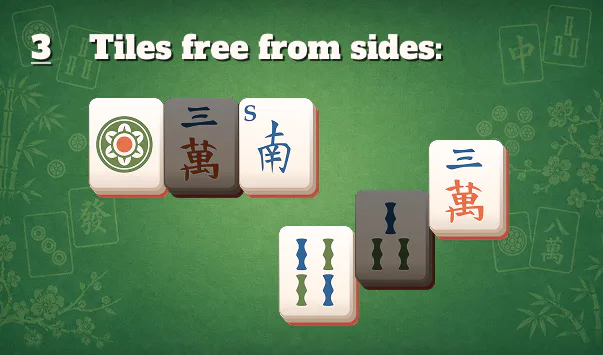
What to do: find a legal pair that removes a covering tile or a horizontal neighbor. Then recheck the target: it may have more than one blocker. If the blocker has no accessible partner, work elsewhere first.
What not to infer: identical pictures do not let you bypass a blocked tile. Nor does removing one covering tile guarantee that the left or right side becomes free. Review the two access checks.
“There are tiles left, but no matches”
Open Matches is above zero
Look for the easily missed exceptions: any flower can match any other flower, and any season can match any other season. The two families do not mix. The bird is one bamboo; the framed white face is a white dragon. Pairs can be far apart and on different layers.
Hint can locate one legal pair. Before your first successful match it is free. After the timer starts it may deduct points. It finds a legal move, not a promise that the move leads to a win.
Open Matches is zero
The current position has no legal pair, so this round cannot continue by normal matching. The game has no Shuffle or Undo. Read the result, note the locked rows or stacks, then use New when you are ready to replace the board.
The generator searches for a deal with a removal path, but its fallback may be random, and later choices can close a path. A loss does not by itself prove a software error or prove that the original deal was impossible. The complete teaching deal illustrates the narrower claim we can verify: one specific arrangement has a 72-pair solution.
“I used a pair, and now the last two copies are trapped”
Consider four two-bamboo tiles. A is at the left end of a row, B is immediately behind A, and an unrelated tile blocks B on the right. C and D are both open elsewhere. Removing C + D spends both easy partners and leaves A in front of B. A cannot match B until B is open.
Removing A + C first opens B's left side and preserves D for B. A + D works for the same reason. This is an access-order problem, not a problem with recognizing the picture. A separate move on B's right might rescue a larger board, but you should not assume that rescue exists.
Choose a pair in the illustrated version →
Does that mean always clear the highest tile?
No. Height is one source of access, and row ends are another. Compare the consequences you can see. A high pair might reveal unknown artwork; a low edge pair might free a known partner immediately. Neither “top first” nor “most tiles opened” guarantees a solution. Move 48 of the teaching deal even opens no additional tiles, yet remains part of a full solution.
“Should I think longer, use Hint, or rush?”
Before the first pair, the clock is stopped. Use that time to find the top tile's partner, inspect the ends of long rows and compare any three-copy choice. Once the first pair is removed, the ten-minute round begins.
During play, an eight-second quick-chain window rewards speed, but missing a chain does not subtract points you already earned. Clearing the board adds 5,000 points. If a pair would spend the last available partner for a blocked copy, checking it is often more useful than chasing the next chain bonus.
After play starts, the first three charged hints cost 85, 150 and 235 points. Repeating the same physical hinted pair is not charged again; a new pair can be. Hint penalties stop at zero. If you keep receiving the same pair, the button is not giving a new strategic recommendation.
Do not compare two final scores as if they measure strategy alone: time between matches, same-type streaks, completion and Hint use all matter. See the worked score calculation.
“The board looks small, or my records disappeared”
Small tiles on a phone
Try landscape orientation, which gives the Turtle board more horizontal room. The page can scroll to the guide below the game. If artwork is missing, check your connection before refreshing: refreshing discards an unfinished round.
Missing saved scores
Scores belong to this browser's local storage. Another browser, private browsing, a different device or cleared site data will not show the same records. Today, This Week and This Month use local calendar boundaries; the week starts on Monday. A record outside the selected period can disappear from that view without being a global ranking change.
When browser storage is unavailable, the site can only keep records for the current page session and displays a notice. It does not provide account-based recovery or unfinished-game saves.
Report a reproducible problem
If a tile still behaves differently from these rules, send a report with your browser, device, orientation, what you selected and what happened. Include a board screenshot if possible, especially the target tile's top, left and right neighbors. Do not send passwords or private account details.
A short review after each round
- Find one row or stack that stayed blocked.
- Ask which earlier pair could have changed its access, without pretending you knew hidden artwork.
- Pick one habit for the next attempt: preserve a partner, inspect an edge, or recheck after each removal.
Some losses depend on hidden information. Review what was visible at the time rather than judging every decision using the finished board.